What your client sees
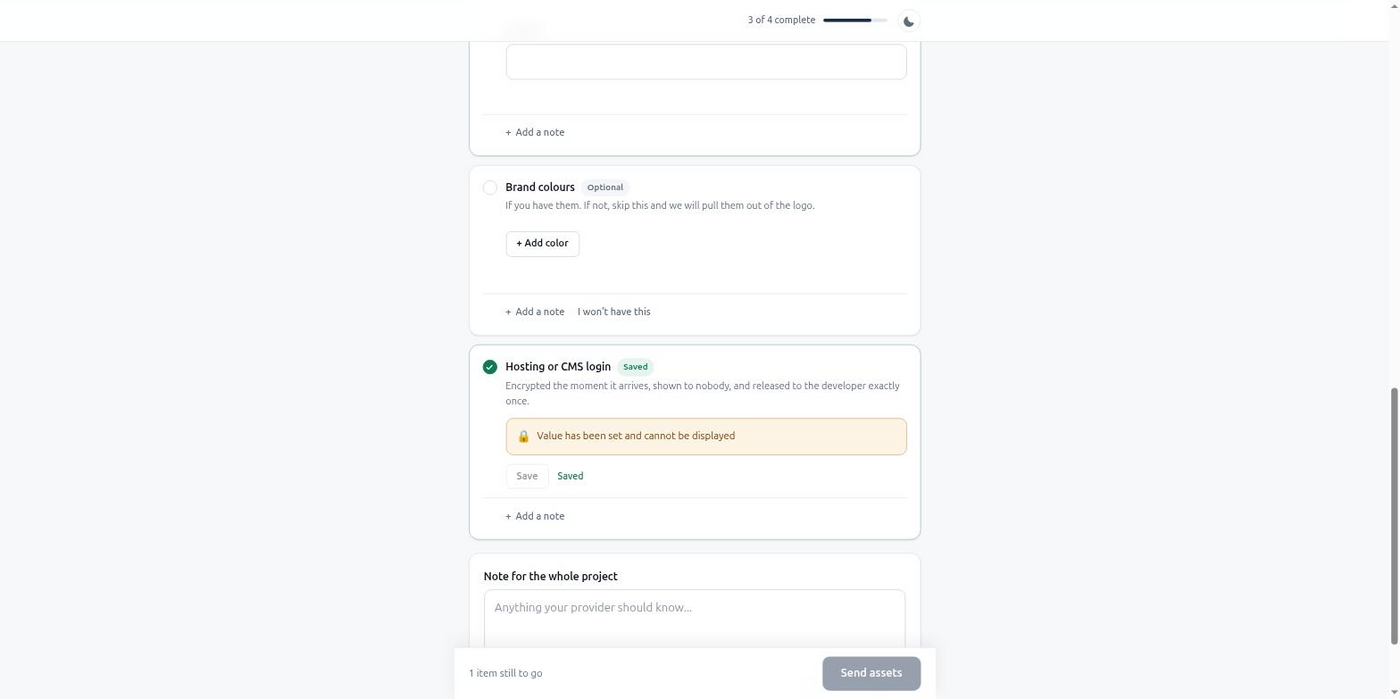
Claude Code, Cursor, or Codex can scaffold a working product in hours. The bottleneck isn't the agent anymore — it's the client's inbox.
You run an AI agency: clients come to you to have something built with a coding agent, fast. The agent genuinely delivers fast. Then it hits the part no model can shortcut — it needs the client's logo, a Stripe key, a support email address, maybe an existing admin login to migrate from — and there is no clean way for an autonomous agent to ask a non-technical person for that and get a structured, usable answer back.
The usual workarounds are worse than the wait:
The agent can build the entire thing before the client has answered a single question — and then it just sits there, session idle, waiting on a reply that may take a week.
define_intake itself, no PM in the loop.aggressive for a same-week deadline — and the agent never has to remember to follow up.intake.completed (or item.submitted for an item-by-item resume) fires the moment the client is done, instead of the agent polling in a loop.get_intake_results and resumes exactly where it paused, with typed data ready to use.Mid-build, the agent realizes it needs brand assets and a live payment key before it can finish integration, and creates the intake itself:
{
  "project_name": "Fintra Onboarding Bot — Assets Needed",
  "client": {
    "name": "Marek Dvorak",
    "email": "[email protected]"
  },
  "items": [
    { "key": "logo", "label": "Company logo", "type": "image", "required": true,
      "constraints": { "formats": ["svg", "png"], "min_width": 512 } },
    { "key": "brand_colors", "label": "Brand colors", "type": "color_list", "required": true },
    { "key": "stripe_key", "label": "Stripe secret key (live or test)", "type": "secret", "required": true },
    { "key": "support_email", "label": "Support inbox address", "type": "text", "required": true }
  ],
  "chase_schedule": "aggressive"
}
The agent also registers a webhook once, with manage_webhook, so it hears about completion instead of checking in a loop. When the client finishes, get_intake_results hands back the logo as a signed URL, the brand colors and support address as plain values, and the Stripe key decrypted on that first call only — the agent stores it immediately, since a second call returns null with a note that it was already revealed.
Custom chase schedules such as aggressive need the Solo plan or higher; on Free the default schedule applies and everything else in this example works as shown.
The agent stops being a relay for copy-pasted requests and becomes the thing that asks, waits, and resumes on its own. Nothing sits in a chat log waiting for you to notice it and forward it along. The client answers once, in a portal built for someone who isn't technical, and the session picks up automatically the moment they're done — no polling, no manual follow-up, no key typed into a message thread.
Connect BriefGate over MCP and let the next build ask for what it needs itself — free to start, no card required.
Free tier, no card required.